Ask ChatGPT the same question twice and you'll often get two different lists of brands. Ask a follow-up and most of those brands disappear.
That's the strange new reality of generative engine optimization. Most GEO guides still treat AI answers like a search results page you can rank on. The data says otherwise.
I read the latest studies on how AI engines pick their sources: a randomized experiment on Google's AI Overviews, an analysis of 1.4 million ChatGPT prompts, and tracking of how ChatGPT's newest model searches the web. This guide turns that research into a practical playbook.
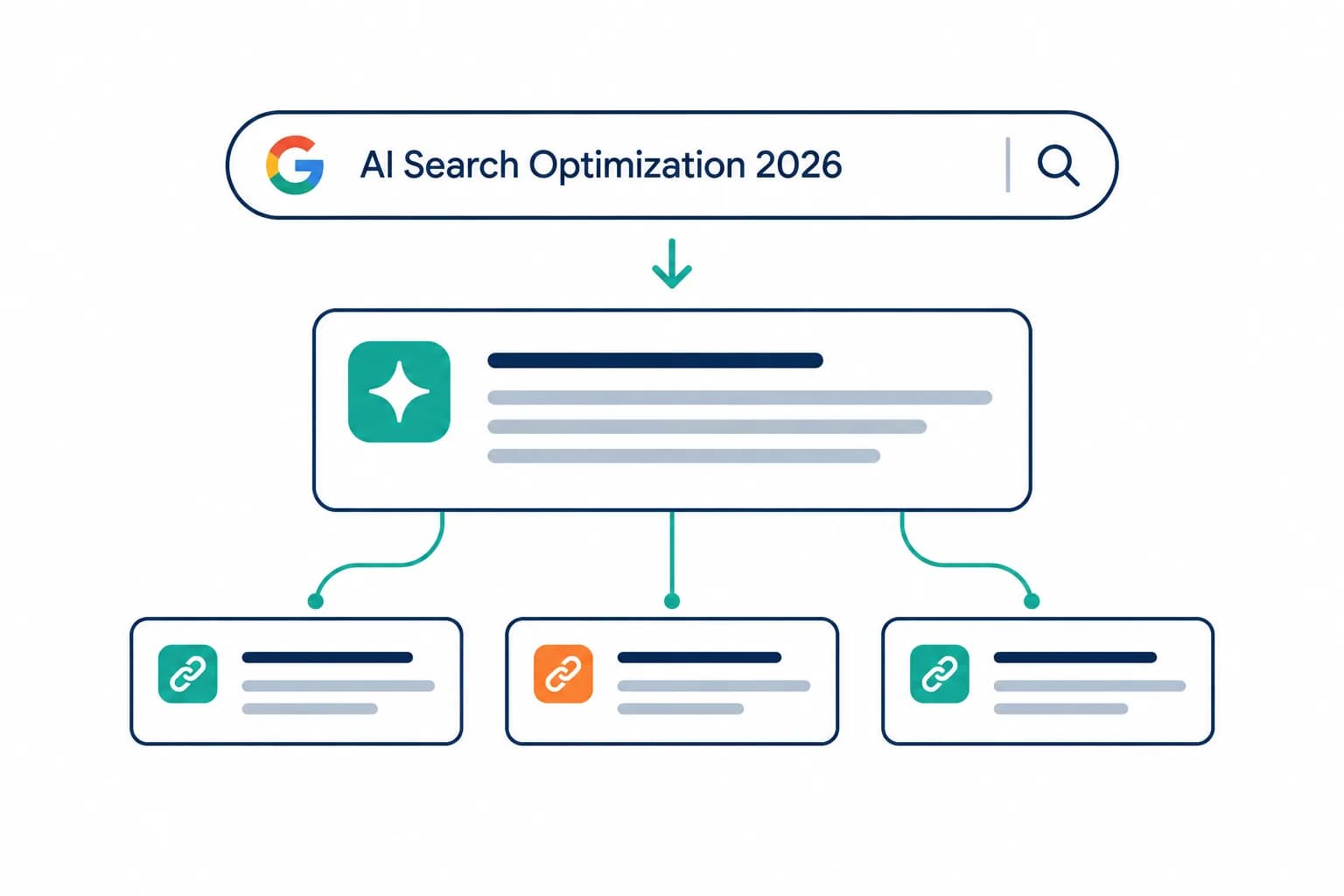
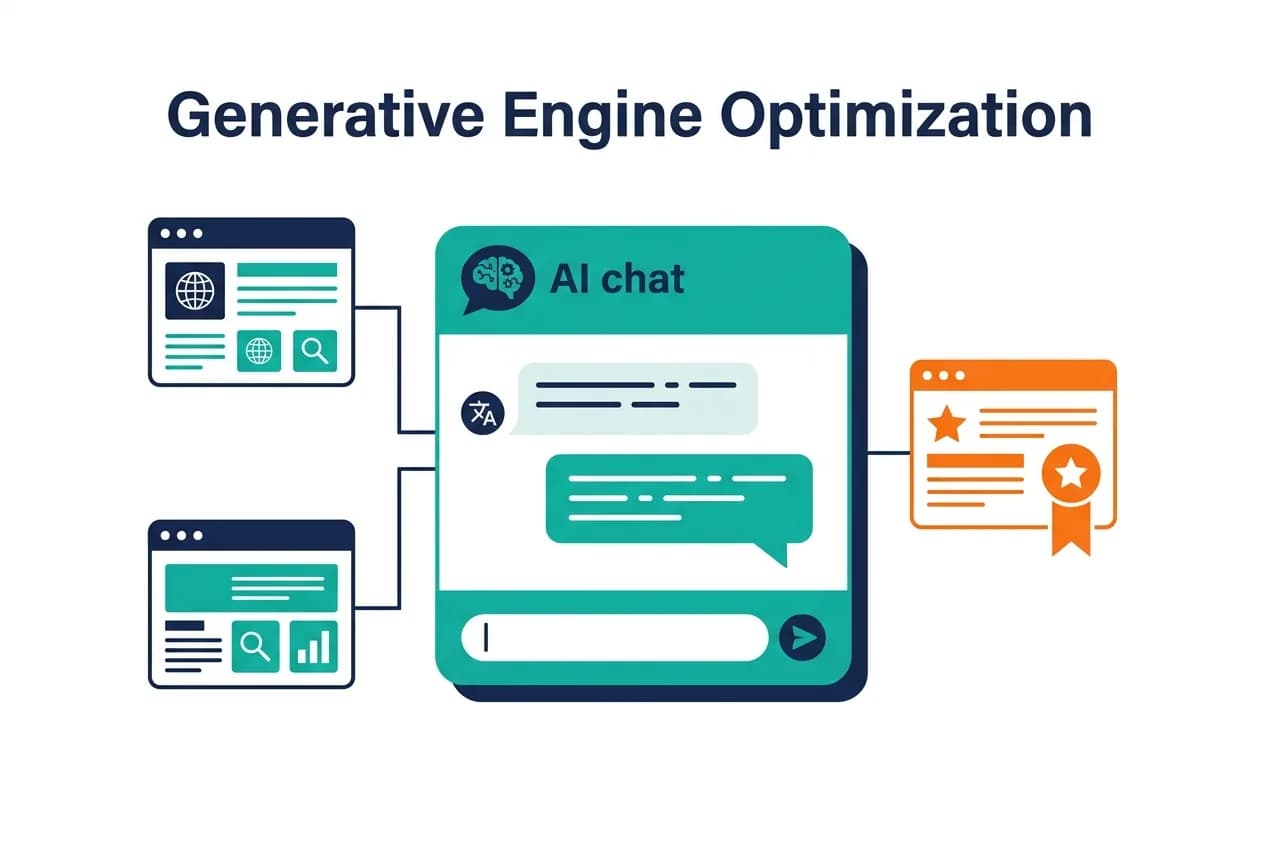
Quick answer: what is generative engine optimization? Generative engine optimization (GEO) is the practice of making your brand and content easy for AI systems like ChatGPT, Google AI Overviews, Gemini, Claude and Perplexity to find, trust, cite and recommend. It builds on SEO, but adds three things: getting into the sources AI engines search, matching the hidden sub-questions they ask, and being mentioned positively on sites they trust.
Key takeaways
- AI Overviews cause a drop in clicks. A randomized study found they cut outbound organic clicks by 39.8%.
- ChatGPT judges your title, URL and snippet before reading your page, and cites only about half of what it retrieves.
- ChatGPT's newest model aimed 76% of its searches at specific websites, up from 22%. Being a site it associates with a topic now matters a lot.
- AI answers are probabilistic. The same brand list repeats less than 1% of the time, so "ranking" in ChatGPT isn't a real metric.
- Free first-party GEO data now exists in Bing Webmaster Tools and Google Search Console.
What generative engine optimization actually is
GEO is about earning a place inside the answer, not just a link below it. The term comes from a 2024 research paper by researchers at Princeton and IIT Delhi. Today it's used for any work that improves how AI systems find, describe and recommend a brand.
You'll see a cluster of near-identical labels:
| Term | Focus | Where it overlaps |
|---|---|---|
| SEO | Ranking pages in search results | The foundation for all of the below |
| GEO | Being cited and recommended in AI-generated answers | Uses SEO signals plus off-site authority |
| AEO | Being the direct answer to a question | Answer-first content, featured snippets |
| LLMO | Shaping how large language models describe a brand | Training data, mentions, entity clarity |
For Google, these distinctions mostly disappear. Google's official AI optimization guide says optimizing for generative AI search is still SEO. Outside Google, the mechanics differ enough that GEO deserves its own playbook.
The three kinds of generative engines
Not every AI engine works the same way, and each needs a different strategy.
- Search-grounded engines (Google AI Overviews, AI Mode, Perplexity, Copilot). They search the web for every answer. Classic SEO and indexing matter most here.
- Hybrid engines (ChatGPT, Gemini, Claude with web search). They answer from memory when they can and search when the question is time-sensitive, specific or contested. You win by being findable when they do search.
- Training-only answers (any model replying without search). The model relies on what it learned. You can only influence this slowly, through a strong presence on sites that feed future training data.
The practical lesson: content an AI can answer from memory rarely gets cited. Content that is specific, current or first-hand forces the model to look you up.
Why GEO matters now: the click loss is proven
For two years, the debate was whether AI answers really cost websites traffic or just coincided with a decline. That question now has a causal answer.
Researchers Saharsh Agarwal and Ananya Sen ran a randomized field experiment with 1,065 desktop Chrome users. A browser extension secretly hid AI Overviews for some users and showed them for others. The results:
- AI Overviews cut outbound organic clicks by 39.8% and raised zero-click searches by 34.5%.
- AI Mode was harsher: about 0.36 external clicks per search vs. 0.53 for normal search, with lower user satisfaction.
- The clicks that disappeared were no lower in quality than the ones that remained. The "less traffic, but better traffic" argument doesn't hold up.
Observational studies point the same way. Ahrefs measured a 58% lower click-through rate for the top-ranking page when an AI Overview appears.
AI is becoming a referral source too
The flip side is that AI tools now send real visitors, and the gap between what they take and what they give back is shrinking.
- Cloudflare Radar data for the 28 days to July 21, 2026 shows OpenAI's GPTBot crawled about 217 pages per referral. Anthropic's ClaudeBot crawled about 2,237, and Google about 4.6.
- OpenAI's ratio improved to 251:1 in July 2026, from 1,104:1 a year earlier. Blocking its crawlers now costs more traffic than it used to.
- Across 13,770 enterprise domains, Conductor found AI referrals averaged 1.08% of all traffic, and 2.80% in IT.
The takeaway for business owners: AI influences far more decisions than its referral numbers show. GEO is about being part of those decisions, whether or not a click follows.
How ChatGPT actually chooses what to cite
ChatGPT drives most AI referral traffic, so it's worth understanding its pipeline step by step. Three recent studies explain most of it.

Step 1: It searches, mostly through Bing-like results
ChatGPT breaks a question into several sub-searches (query fan-out), then pulls candidate pages. A Seer Interactive analysis found 87% of SearchGPT citations match Bing's top-10 organic results, vs. 56% for Google's. If you ignore Bing, you're ignoring ChatGPT's candidate pool.
Step 2: It judges your title and URL before reading your page
Ahrefs studied 1.4 million ChatGPT prompts and found ChatGPT cites only about half the URLs it retrieves. Before opening a page, it sees a title, URL and short snippet. That metadata acts as a gatekeeper.
- Titles that match the sub-questions win. Similarity between the prompt and cited page titles averaged 0.602, vs. 0.484 for pages that weren't cited. Against the fan-out queries, cited titles scored 0.656.
- Readable URLs help. Search results with natural-language slugs had an 89.78% citation rate, vs. 81.11% without.
- Ranking still matters. About 88% of cited URLs came through ChatGPT's general search channel.
- Reddit is read, rarely credited. Reddit content was cited only 1.93% of the time. ChatGPT uses it to understand consensus, then cites someone else.
Step 3: The newest model decides which websites to search
This is the biggest shift of 2026. Seer compared GPT-5.5 with GPT-5.6 Luna across 346 matched prompts:
| Measure | GPT-5.5 | GPT-5.6 Luna |
|---|---|---|
| Fan-out queries using site: search | 21.6% | 76% |
| Open searches (any site can appear) | 575 | 175 |
| Sources consulted | 6,134 | 3,481 |
| Inline citations | 2,054 | 1,790 |
Even on prompts that named no brand, Luna chose specific domains to search 77.3% of the time. In plain terms, ChatGPT now decides which websites to look at before reading any content.

That changes the GEO goal. It's no longer enough to have a great page. ChatGPT has to already associate your site with the topic, or it may never search you at all. Third-party coverage still matters even on brand questions: about a quarter of sources on branded prompts were publishers, review sites and research organisations.
Pillar 1: Technical GEO (can AI reach you at all?)
Most GEO problems I find on audits are access problems, not content problems. Fix these first.
Allow the right crawlers, by job
Each AI company now runs separate bots for search, user requests and training. Block the wrong one and you vanish from answers.
| Company | Search / answers | Live user fetches | Training only |
|---|---|---|---|
| OpenAI | OAI-SearchBot | ChatGPT-User | GPTBot |
| Anthropic | Claude-SearchBot | Claude-User | ClaudeBot |
| Googlebot (Search, AI Overviews, AI Mode) | — | Google-Extended (Gemini) |
Two common mistakes:
- Old Anthropic names. Anthropic used to run under Claude-Web and Anthropic-AI. Rules using those names no longer apply to its current crawlers.
- Treating GPTBot as the ChatGPT search bot. OpenAI says sites that block OAI-SearchBot won't appear in ChatGPT search answers. GPTBot only controls training.
Check your Cloudflare settings
This one is new and easy to miss. On July 1, 2026, Cloudflare announced that from September 15 it would block "mixed-use" AI crawlers by default on pages that show ads. The default covers new customers, new sites and all free-tier accounts. Pure search crawling stays allowed.
If you or your clients run ad-supported sites on Cloudflare, open the bot settings and decide deliberately: allow, charge or block, per crawler.
Render content on the server
Google renders JavaScript. Most AI crawlers don't. Vercel's crawl study found none of the major AI crawlers execute JavaScript, even though they download JS files.
If your prices, specs or FAQs load client-side, ChatGPT and Claude see an empty page. Use server-side rendering or static generation for important content.
Quick test: run curl -A "OAI-SearchBot" https://yoursite.com/page and search the output for your main heading and key facts.
Get into Bing
Because ChatGPT's citations track Bing so closely, Bing is a GEO channel in its own right.
- Verify your site in Bing Webmaster Tools and check indexing for your priority pages.
- Submit new and updated URLs with IndexNow so Bing picks up changes quickly.
- Check your Bing rankings for priority topics. If you aren't in Bing's top 20, you're unlikely to be in ChatGPT's candidate set.
Pillar 2: Content GEO (will AI choose and trust you?)
Good GEO content is content an AI can't write from memory. If a model can answer the question without you, it has no reason to cite you.
Write non-commodity content
Google's guide draws a clear line. A generic piece like "7 Tips for First-Time Homebuyers" is commodity content. A first-hand piece about one buyer's decision, with real details, is not. AI engines need the second kind because they can't invent it.
Content types that force a model to look you up:
- Original data: benchmarks, surveys, test results, anonymised client numbers.
- Current facts: pricing, comparisons, release notes, anything time-sensitive.
- First-hand experience: what you tried, what broke, what you'd do differently.
- Tools and calculators that answer a specific question.
Show E-E-A-T a reader can verify
Experience, expertise, authoritativeness and trust aren't a score. They're the evidence a sceptical reader, or model, checks.
- Experience: first-person detail, screenshots, real numbers.
- Expertise: a named author with a real bio and links to their work.
- Authority: mentions and citations from respected sites in your niche (Pillar 3).
- Trust: named sources for every statistic, visible update dates, clear About and Contact pages.
Write titles and URLs for the hidden sub-questions
Since ChatGPT filters on title, URL and snippet first, these are now your highest-leverage GEO edits.
- Ask ChatGPT, Gemini and Perplexity your customer's real questions. Note the sub-questions they search for.
- Rewrite titles so they directly answer one of those sub-questions in plain language.
- Use short, descriptive URL slugs, like
/geo-vs-seo-differences/, not/p?id=4821. - Make the meta description a one-sentence answer. It may become the snippet the model reads.
- Open each section with its answer, then support it with evidence.
Pick formats each engine prefers, carefully
Format matters, but the patterns differ by engine and change with each model release.
- Evertune's analysis of around 25,000 heavily cited URLs found half were listicles, and 63% of nearly 400 million citations pointed to listicles. Most cited pages ran 1,000 to 2,000 words with clear H2s and H3s.
- Peec's data shows Google AI Mode leans toward brands' own category and product pages, and that GPT-5.6 shifted ChatGPT toward product pages too.
- Caution: Google has signalled a crackdown on promotional listicles. Self-serving "best X" lists that rank yourself first are a risk. Use an honest method and include competitors fairly.
Pillar 3: Authority GEO (what does the web say about you?)
AI engines rely heavily on what others say about you. That makes off-site work the most powerful, and most neglected, part of GEO.
The evidence is consistent:
- Ahrefs found across 75,000 brands that branded web mentions correlated at 0.664 with AI Overview visibility, vs. 0.218 for backlinks.
- Scrunch's data on 442M+ citation events shows 87.2% came from third-party sources, not the brand's own site.
- In an AIVO study of beauty brands, brand-owned sites were just 2.4% of 3,814 citations.
Semantic contextual link building
Classic link building chases authority scores. Semantic contextual link building chases relevance: your brand named, linked or not, inside content that is about your topic, next to the terms and entities that define it.
This matters more now that ChatGPT picks which domains to search before it searches. If respected sites consistently connect your brand to a topic, the model is more likely to treat you as a source for that topic.
Example: a mention on a general lifestyle blog carries little topical meaning. A mention inside a technical article on JavaScript rendering for AI crawlers, naming your agency alongside server-side rendering and robots.txt, puts you squarely in your topic's neighbourhood.
Tactics that build topical authority
- Publish original research. Data gets cited by journalists and bloggers, which earns mentions in exactly the right context.
- Earn expert commentary. Quotes in industry publications place your name beside your topic, written by someone else.
- Get into the lists and comparisons AI reads. Review sites, industry roundups and comparison articles are common AI sources for buying questions.
- Be genuinely present on Reddit and in communities. ChatGPT reads Reddit to understand consensus, even if it rarely cites it. Your reputation there shapes how AI describes you.
- Use YouTube. In Ahrefs' follow-up research, YouTube mentions showed the strongest correlation with AI brand visibility, around 0.737.
- Link internally with descriptive anchors. Build clear topic clusters on your own site so both crawlers and fan-out searches can follow the thread.
Publish a "brand canon"
AI engines repeat outdated or wrong facts. AIVO found one engine still claiming a brand held B Corp certification after the brand publicly dropped it.
Keep one up-to-date page of your key facts: what you do, who you serve, pricing approach, certifications, locations and leadership. Link to it from your About page, and correct outdated third-party listings that contradict it. Seer calls this defining what "correct" means before you measure visibility.
What to avoid
- Fake or paid mentions. Google says inauthentic mentions aren't as helpful as they seem, because its spam systems apply to AI features too.
- Writing your own Wikipedia page. Wikipedia's conflict-of-interest guideline advises anyone with a financial connection not to edit directly. Earn coverage that independent editors can cite.
Measuring GEO without fooling yourself
AI answers are probabilistic, so the way most people check their AI visibility is misleading. One prompt, one screenshot, one "we're #2 in ChatGPT" tells you almost nothing.
Why single checks mislead
- Lists rarely repeat. SparkToro and Gumshoe ran 2,961 prompts through ChatGPT, Claude and Google AI. There was less than a 1-in-100 chance of getting the same brand list twice, and under 0.1% for the same order. (Gumshoe sells AI tracking tools.)
- But how often you appear is stable. In the same study, top headphone brands appeared in 55% to 77% of responses, even as positions changed.
- Follow-ups remove most brands. Clovion's study of multi-turn conversations found 62% of recommended brands vanished after one follow-up. Adding "for a small team" kept only 28%. Treat these figures as directional; the study was corrected after publication.

The KPIs worth tracking
| KPI | What it tells you | How to measure |
|---|---|---|
| Visibility rate | How often you appear for a topic | Run each prompt 20+ times; % of runs you appear in |
| Follow-up survival | Whether you stay in the answer as buyers get specific | Add realistic follow-ups to each prompt |
| Share of citations | Your citations ÷ all citations in the category | AI tracking tool or manual logging |
| Answer accuracy | Whether AI describes you correctly | Score answers against your brand canon |
| AI-influenced conversions | Business impact | GA4 AI referrals + branded search + direct traffic trends |
The last three come from Seer's "Be Seen, Be Believed, Be Chosen" framework. Its research across 1,094 categories shows why share matters: if the citation pool doubles while yours grows 10%, your real share has halved.
If you'd rather automate the logging, our independent comparison of the best GEO tools covers which engines each one tracks and what the entry plans cost.
Free first-party data you should be using
- Bing Webmaster Tools AI Performance. Launched February 10, 2026. It shows which pages Copilot and Bing AI cite, plus the grounding queries behind those citations. Those are real fan-out queries: use them to rewrite titles. A June 2026 update added citation share, intents and topics.
- Google Search Console Generative AI report. Launched June 3, 2026. It shows impressions in AI Overviews and AI Mode by page, but no clicks or queries yet.
- GA4 AI referrals. Segment chatgpt.com, perplexity.ai, gemini.google.com, claude.ai and copilot.microsoft.com. Since ChatGPT started showing ads, Seer advises treating AI referral numbers as a mix of paid and organic until you've checked your UTMs.
Annotate model updates
Treat AI model releases like Google core updates. When GPT-5.6 Luna became ChatGPT's default, inline citations fell about 13% across the board. Seer's advice: mark the switch in your reports, so a platform-wide drop isn't read as a failed campaign.
GEO myths that waste your time
| Myth | What the evidence says |
|---|---|
| "Schema markup gets you cited" | A controlled Ahrefs test of 1,885 pages vs. 4,000 controls found no meaningful citation lift on AI Overviews, AI Mode or ChatGPT. Keep schema for rich results. |
| "You need llms.txt" | Google Search ignores llms.txt. It's harmless, but not a visibility lever for Google. |
| "GEO tactics boost visibility 40%" | That figure came from a lab setup. A later NeurIPS benchmark found most such tactics largely ineffective, with traditional SEO more effective. |
| "Track your ChatGPT ranking" | Lists repeat under 1% of the time. Track visibility rate instead. |
| "Content goes stale in six months" | ChatGPT's cited pages had a median age of about 500 days. Freshness acts as a tie-breaker, especially for news. |
| "Blocking GPTBot keeps you out of ChatGPT search" | GPTBot is for training. ChatGPT search uses OAI-SearchBot. |
A 30-day GEO plan
- Week 1 — Access: audit robots.txt by crawler job, remove old Anthropic names, check Cloudflare AI bot settings, and curl-test your top 20 pages for server-rendered content.
- Week 1 — Baseline: verify Bing Webmaster Tools and Search Console, set up a GA4 AI referral segment, and run 20 buyer prompts 20 times each on ChatGPT, Gemini and Perplexity. Log visibility rate and follow-up survival.
- Week 2 — Brand canon: publish your key-facts page. Score current AI answers against it and list every wrong fact and its likely source.
- Week 2 — Titles and URLs: pull Bing grounding queries and ChatGPT fan-out queries. Rewrite titles, slugs and meta descriptions on your 10 most important pages to match them.
- Week 3 — Content: add first-hand data, a named expert author and sourced statistics to your five most valuable pages. Fix any content that loads only via JavaScript.
- Week 4 — Authority: plan one piece of original research. List 10 topically relevant publications, review sites, podcasts or communities, and start pitching.
- Day 30 — Review: re-run the same prompt set and compare visibility rate, follow-up survival, accuracy and share of citations. Note any model updates during the month.
Frequently asked questions
What is generative engine optimization?
GEO is the practice of making your brand and content easy for AI systems like ChatGPT, Google AI Overviews, Gemini, Claude and Perplexity to find, trust, cite and recommend.
What's the difference between GEO and SEO?
SEO earns rankings in search results. GEO earns mentions and citations inside AI answers. GEO builds on SEO, but adds AI crawler access, titles matched to AI sub-queries, and off-site authority.
Is GEO the same as AEO?
They overlap heavily. AEO focuses on being the direct answer to a question. GEO is broader and includes how AI describes and recommends your brand.
How do I get cited by ChatGPT?
Allow OAI-SearchBot, rank in Bing, write titles and URLs that match the sub-questions ChatGPT searches, and earn mentions on sites ChatGPT already trusts for your topic.
Can I track my ranking in ChatGPT?
Not reliably. The same brand list repeats less than 1% of the time. Track how often you appear across many runs instead.
Does schema markup help GEO?
A controlled study found no citation lift from adding schema. Keep it for Google rich results, but don't rely on it for AI visibility.
How long does GEO take?
Technical fixes like crawler access, rendering and titles can show results within weeks. Topical authority from mentions and research builds over months.