I spent a week reading every AI search optimization guide I could find. Most of them contradicted each other, and a surprising number contradicted their own sources.
One said schema markup is the key to AI visibility. Google's own documentation says it isn't required. Another quoted a Princeton study as proof that "GEO boosts visibility 40%." A later peer-reviewed benchmark found most of those tactics don't work and can even hurt.
So I did what I do on client audits. I went back to the primary sources, checked the numbers, and kept only what held up.
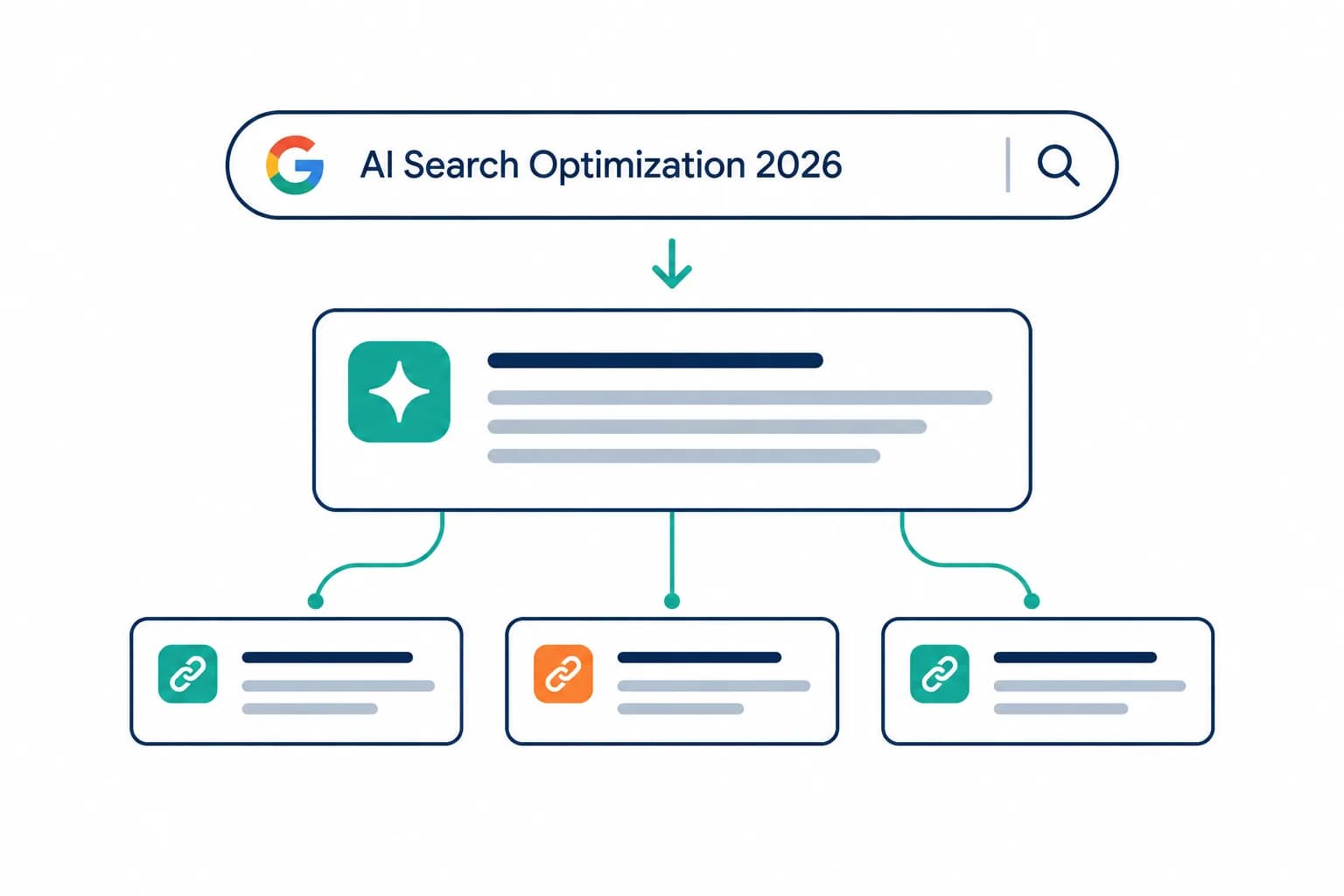
Quick answer: what is AI search optimization? AI search optimization is the practice of making your content easy for AI systems like Google AI Overviews, AI Mode, ChatGPT and Perplexity to find, trust and cite. For Google, it is still SEO: AI answers are built from Google's core ranking systems. For ChatGPT and Claude, it adds three things: crawler access, server-rendered HTML, and earned mentions across the web.
Key takeaways
- AI Overviews cut clicks roughly in half. Pew measured an 8% click rate with an AI summary vs. 15% without.
- Ranking no longer guarantees citation. Only 38% of AI Overview citations came from top-10 pages in 2026, down from 76% in 2025.
- Off-site brand mentions correlate with AI visibility 3x more strongly than backlinks (0.664 vs. 0.218).
- Schema, llms.txt and "chunking" show no measurable effect on AI citations in controlled tests or official guidance.
- Most AI crawlers cannot run JavaScript. If your content renders client-side, ChatGPT and Claude see a blank page.
What AI search optimization actually means
AI search optimization means earning a place inside AI-generated answers, not just a blue link below them. The goal shifts from "rank #1" to "be one of the sources the answer is built from."
You'll see three labels used almost interchangeably:
| Term | Stands for | What people usually mean |
|---|---|---|
| SEO | Search engine optimization | Ranking pages in search results |
| AEO | Answer engine optimization | Getting your content used as the direct answer |
| GEO | Generative engine optimization | Getting cited inside AI-generated responses |
Google doesn't treat these as separate disciplines. Its official AI optimization guide says that, from Google Search's perspective, optimizing for generative AI search is still SEO.
How AI answers are built: retrieval and fan-out
Two mechanisms decide whether your page gets used. Understanding them explains almost every tactic that works.
-
Retrieval-augmented generation (RAG). The AI doesn't answer from memory alone. Google's guide describes it pulling relevant pages from its search index through core ranking systems, then writing a response with links to those pages. No retrieval means no citation.
-
Query fan-out. The model splits one question into several related searches. Google's example: a question about a weedy lawn fans out into searches about herbicides, chemical-free removal and prevention. Your page can be cited for a query you never targeted, as long as it answers one of the sub-questions well.

Fan-out is the reason topical depth beats keyword targeting. A page that covers a subject's real sub-questions gets more chances to be retrieved.
Not all AI search engines work the same way
ChatGPT, Claude and Perplexity run their own crawlers and retrieval. They don't inherit Google's index or its JavaScript rendering. That is why a page ranking #1 on Google can still be invisible in ChatGPT, and why this guide treats Google and the other engines separately where the evidence differs.
The traffic reality: why this matters now
AI answers are taking clicks from organic results, and AI referrals don't yet replace them. Three independent studies, using three different methods, point the same way.

| Study | Method | Finding |
|---|---|---|
| Pew Research Center (July 2025) | 900 US adults, 68,879 real searches | Users clicked a result in 8% of visits with an AI summary vs. 15% without. Only 1% clicked a cited source inside the summary. |
| Ahrefs (Dec 2023 vs. Dec 2025) | 300,000 keywords, Search Console data | Position-1 CTR was 58% lower when an AI Overview appeared, up from a 34.5% drop measured in April 2025. |
| Seer Interactive (Jan 2025–Feb 2026) | 53 brands, 5.5M queries | Organic CTR on AI Overview queries fell to 1.31%, then recovered to 2.36%. Being cited earned 120% more clicks, but still 38% fewer than queries with no AI Overview. |
Sources: compiled in Advanced Web Ranking's CTR study.
The Seer finding is the one I'd put in front of a client. Being cited doesn't restore your old traffic. It does make you the best-performing result on a page that now sends fewer clicks overall.
How big is AI referral traffic?
Still small, but growing fast and unevenly by industry.
- Conductor's benchmark of 13,770 enterprise domains and 3.3 billion sessions found AI referrals averaged 1.08% of all website traffic. IT sites saw the most, at 2.80%.
- ChatGPT dominates but is losing share. Goodie's longitudinal report measured ChatGPT's share of AI referrals falling from 89.1% to 62.6% between its two study waves.
- McKinsey's research found 50% of consumers intentionally use AI-powered search for purchase decisions, and 44% of those users call it their primary source. Only 16% of brands systematically track their AI search performance.
Scale matters too. At Google I/O 2026, Google reported AI Overviews at 2.5 billion monthly users and AI Mode at over 1 billion.
Ranking vs. citation: the link has weakened
Ranking still helps you get cited, but it is no longer a reliable predictor. The data moved fast in under a year.

This doesn't contradict Google's "it's still SEO" message. It's query fan-out at work: the AI cites pages ranking for sub-questions, not just the head term. Ranking well across a topic matters more than ranking for one keyword.
Each AI surface picks different sources
- AI Overviews vs. AI Mode: only 13.7% URL overlap, despite both being Google products (Ahrefs, Dec 2025, compiled by The Digital Bloom).
- ChatGPT vs. Google: only 6.82% of ChatGPT results overlap with Google's top 10, and 28.3% of ChatGPT's most-cited pages have zero Google visibility (same source).
- Favourite sources differ: Profound's citation analysis found Wikipedia is ChatGPT's top source at 7.8% of citations, while Reddit leads for AI Overviews (2.2%) and Perplexity (6.6%).
The practical lesson: track each platform separately. A single "AI visibility score" hides more than it shows.
Step 1: Fix the technical foundation first
If an AI system can't fetch and read your page, nothing else in this guide matters. This is where I find the biggest, cheapest wins on audits.
Meet Google's eligibility requirements
Google's guide sets two conditions. A page must be indexed and eligible to show with a snippet. And the site must be included in Search generative AI features in Search Console. That second setting is new, so check it on every property.
Allow the right crawlers (they are not all the same)
Most robots.txt advice mixes up training crawlers with search crawlers. They do different jobs, and blocking the wrong one costs you citations.

| User agent | Owner | What it does | Block it and you lose... |
|---|---|---|---|
| Googlebot | Crawls for Search, AI Overviews and AI Mode | Google Search and AI Overviews | |
| Google-Extended | A control token for Gemini training and grounding | Gemini training/grounding only. Not AI Overviews. | |
| OAI-SearchBot | OpenAI | Surfaces sites in ChatGPT search | Appearing in ChatGPT search answers |
| GPTBot | OpenAI | Collects content for model training | Future training data only |
| ChatGPT-User | OpenAI | Fetches pages on a user's request | Live fetches. Not used for search inclusion. |
| Bytespider | ByteDance | Feeds TikTok, Toutiao and Doubao | ByteDance products |
A common setup: allow OAI-SearchBot, Googlebot and the other search crawlers, then decide on training crawlers as a separate business choice.
Render your content on the server
This is the most overlooked issue I see on modern JavaScript sites. Google renders JavaScript. Most AI crawlers don't.
Vercel and MERJ's crawl study found none of the major AI crawlers execute JavaScript. GPTBot made 569 million requests in a month on Vercel's network. It fetched JS files in 11.50% of requests, and ClaudeBot in 23.84%, but neither ran them.
If your product details, pricing or FAQs load client-side, they are invisible to ChatGPT and Claude. Use server-side rendering or static generation for main content. In Next.js, that means keeping important copy in server components or pre-rendered pages, and leaving client-side rendering for interactive extras.
Quick test: run curl -A "OAI-SearchBot" https://yoursite.com/page and search the output for your main heading. If it's missing, so is your page in ChatGPT.
Keep the basics clean
Google's guide still lists the usual foundations: crawlable pages, good page experience, reduced duplicate content, and following JavaScript SEO best practices. Nothing about AI search replaces them.
Step 2: Publish content nobody else could have written
Google says this one factor will likely matter more over time than anything else in its guide. It calls it non-commodity content.
Commodity content restates common knowledge. Google's example is "7 Tips for First-Time Homebuyers." Non-commodity content adds first-hand expertise, like a piece on why one buyer waived the inspection and what they found in the sewer line. AI can already write the first kind. It needs you for the second.
What non-commodity content looks like in practice
- Original data. Your own benchmarks, test results, survey numbers or anonymised client results.
- First-hand process. What you did, what broke, what you'd change. Screenshots and real numbers beat adjectives.
- A clear point of view. Take a position and defend it with evidence, like this guide does on schema.
- Useful visuals. Google notes its AI features can surface images and video, so original diagrams and charts create extra chances to appear.
Human-led content still wins. Graphite's study found 86% of articles ranking in Google Search are human-written, and 82% of articles cited by ChatGPT and Perplexity are human-written. AI can help you draft. It shouldn't be the source of the insight.
Build E-E-A-T signals readers (and machines) can verify
E-E-A-T stands for experience, expertise, authoritativeness and trustworthiness. It isn't a score you can game. It's a set of signals a sceptical reader would check.
| Signal | How to show it |
|---|---|
| Experience | First-person detail: "we tested", "on a client site we saw", with screenshots or data |
| Expertise | A named author with a real bio, credentials and links to their work |
| Authoritativeness | Mentions and citations from respected sites in your niche (see Step 3) |
| Trust | Accurate claims, named sources, visible update dates, clear About and Contact pages |
For health, finance and legal topics (YMYL), the bar is higher. Expect to need named experts and referenced sources before AI systems will cite you.
Structure pages for people (which also helps AI)
Answer-first writing works because it serves readers who skim. Google's guide asks for clear paragraphs, sections and headings that help people navigate. It does not ask for formula-length chunks.
- Open each section with its answer in one or two sentences.
- Use descriptive H2s and H3s that match the sub-questions people actually ask.
- Put comparisons in tables and steps in numbered lists.
- Cite named sources for every statistic.
- Show a visible "last updated" date and actually update the facts.
On freshness, keep perspective. Ahrefs' study of 17 million citations found AI-cited URLs were 25.7% fresher than organic results, but still averaged 1,064 days old. AI Overviews actually cited slightly older content than organic search. Update when facts change, not on an arbitrary schedule.
Step 3: Semantic contextual link building and brand mentions
Off-site signals have the strongest relationship with AI visibility of anything measured so far. But the signal that matters most isn't the backlink. It's the mention.
Ahrefs analysed 75,000 brands and found branded web mentions correlated at 0.664 with AI Overview visibility. Backlinks correlated at 0.218. Brands in the top quartile for mentions averaged 169 AI Overview mentions, more than 10 times the next quartile's 14. These are correlations, not proof of cause, but the gap is large and consistent.

AI answers also lean heavily on what others say about you. Scrunch's analysis of 442M+ citation events found 87.2% came from third-party sources, not the brand's own site. For unbranded prompts, third parties supplied 89.6% of answers.
What "semantic contextual" link building means
Traditional link building chases authority metrics. Semantic contextual link building chases relevance: your brand mentioned, linked or not, inside content that is about your topic, next to the entities and terms that define it.
An AI system reading that article learns the association: this brand is connected to this subject. That is the signal that seems to carry into AI answers.
Example: a link from a high-authority lifestyle blog saying "great agency!" carries little topical meaning. A mention inside a technical article on JavaScript rendering for search crawlers, naming your consultancy alongside SSR and Core Web Vitals, places you right in your topic's semantic neighbourhood.
Tactics that hold up
- Publish citable original data. Studies and benchmarks earn mentions because journalists and bloggers need sources. This is the cleanest way to earn links that sit in context.
- Digital PR around expertise. Expert commentary in industry publications puts your name next to your topic, written by someone else.
- Contribute where your audience asks questions. Answer genuinely on Reddit, industry forums and LinkedIn. Profound found Reddit is the top cited source for Perplexity and AI Overviews. Spam gets removed and helps no one.
- YouTube. In Ahrefs' follow-up study, YouTube mentions showed the highest correlation with AI brand visibility, at about 0.737.
- Partner and integration pages. Co-authored case studies and listings on partner sites are relevant mentions by design.
- Internal linking with descriptive anchors. Link your own related pages using topic-rich anchor text. This builds a clear topic cluster that both crawlers and fan-out retrieval can follow.
What to avoid
- Fake or paid mentions. Google says inauthentic mentions aren't as helpful as they seem, because its AI features rely on the same spam-blocking systems as Search.
- Writing your own Wikipedia page. Wikipedia's conflict-of-interest guideline strongly discourages it, and paid edits require disclosure. Earn independent coverage that editors can cite instead.
- Local businesses chasing PR first. For local queries, listings matter more. Google recommends Business Profile and Merchant Center feeds for product and local visibility in AI responses. See our local search service.
Myths to ignore (and the evidence against them)
A lot of AI search optimization advice is sold harder than it is tested. Here's what the controlled evidence and official documentation actually say.
| Popular claim | What the evidence shows | Source |
|---|---|---|
| "Schema markup gets you cited by AI" | A controlled test of 1,885 pages that added JSON-LD, against 4,000 control pages, found no meaningful citation uplift on AI Overviews, AI Mode or ChatGPT. Google says no special schema is needed. | Ahrefs study summary; Google |
| "You need an llms.txt file" | Google Search ignores llms.txt. Creating one neither helps nor hurts Google visibility. | |
| "Chunk content into small AI-friendly blocks" | Google says there's no requirement to break content into tiny pieces, and no ideal page length. | |
| "GEO tactics boost visibility 40%" | The 2024 study rewrote one of five fixed sources with GPT-3.5 in a lab setup. A 2025 NeurIPS benchmark found most such methods largely ineffective, often harmful, and that traditional SEO was significantly more effective. | GEO paper; C-SEO Bench |
| "Write separate pages for every query variation" | Google says doing this to manipulate AI answers violates its scaled content abuse policy. | |
| "Blocking Google-Extended removes you from AI Overviews" | Google-Extended controls Gemini training and grounding. AI Overviews run on Googlebot. | PPC Land |
| "Content goes stale after six months" | AI-cited URLs averaged 1,064 days old. Freshness helps, but there's no six-month cliff. | Ahrefs |
A note on schema
Keep schema. It still makes pages eligible for rich results in regular Search, which Google recommends. Just don't sell it to a client, or to yourself, as an AI citation lever. Put the time into visible content and server rendering instead.
Where the GEO research is still useful
The original study's direction is sensible: cited sources, real statistics and quotations from named experts make content more credible. Those are just good writing. What doesn't hold up is the idea that they're a formula with a guaranteed lift, or that you need a statistic every 150 words.
Step 4: Measure what you can (and know the limits)
You can now measure Google AI visibility directly, but only partly.
Google launched Search Generative AI performance reports in Search Console on June 3, 2026. They show impressions within AI Overviews, AI Mode and Discover's AI features, by page, country, device and date. The report currently shows impressions only: no clicks, CTR, position or queries.
A practical measurement stack:
- Search Console Generative AI report: which pages appear in Google's AI features.
- GA4 referral segment: sessions from chatgpt.com, perplexity.ai, gemini.google.com, claude.ai and copilot.microsoft.com.
- Server logs: confirm OAI-SearchBot, PerplexityBot and Claude-SearchBot actually fetch your key pages and get full HTML.
- Manual prompt checks: ask 20–30 real customer questions on each platform monthly and log who gets cited.
- Brand mention tracking: count new mentions on relevant sites each month, since that's the strongest correlated signal.
Google warns that no third-party tool has access to its internal ranking or AI systems. Use tracking tools for trends, not as truth.
A 30-day AI search optimization plan
- Week 1 — Access: check the Search Console AI eligibility setting, audit robots.txt by crawler type, and curl-test your top 20 pages for server-rendered content.
- Week 1 — Baseline: export the Generative AI report, set up the GA4 AI referral segment, and run your first prompt check.
- Week 2 — Content: pick your five highest-value pages. Add first-hand data, a named expert author, sourced statistics and an answer-first opening to each section.
- Week 3 — Mentions: plan one piece of original data or research. List 10 topically relevant publications, podcasts or communities to pitch.
- Week 4 — Clusters: map the sub-questions around your main topic, fill the gaps, and connect pages with descriptive internal links.
- Day 30 — Review: compare AI impressions, AI referrals and prompt-check citations against your baseline.
References
All sources were accessed in October 2026.
- Google Search Central — Optimizing your website for generative AI features on Google Search
- Google Search Central Blog — Introducing Search Generative AI performance reports in Search Console (June 3, 2026)
- OpenAI — Overview of OpenAI crawlers
- Advanced Web Ranking — Google Organic CTR study, compiling Pew, Ahrefs and Seer data
- Ahrefs — 76% of AI Overview citations pull from top 10 pages (2025)
- Search Engine Journal — Google AI Overview citations from top-ranking pages drop sharply
- Ahrefs — AI Overview brand visibility factors (75K brands)
- Ahrefs — AI assistants prefer to cite fresher content (17M citations)
- Vercel and MERJ — The rise of the AI crawler
- Aggarwal et al. — GEO: Generative Engine Optimization (KDD 2024)
- Puerto et al. — C-SEO Bench: Does Conversational SEO Work? (NeurIPS 2025)
- Graphite — AI content in search and LLMs
- Profound — AI platform citation patterns
- Scrunch — Citation dynamics
- Summary of the Ahrefs controlled schema study — Schema and AI search: what the research says
- Analyze AI — Conductor AI traffic benchmark summary
- Goodie — 2026 AI search traffic report
- The Media Leader — McKinsey research on AI search
- The Digital Bloom — 2026 AI citation position report
- PPC Land — Google-Extended explained · Bytespider explained
- Wikipedia — Conflict-of-interest editing on Wikipedia
- Digital Applied — Google I/O 2026 AI Overviews and AI Mode user figures
- Pasquale Pillitteri — What the Search Console Generative AI report shows
Frequently asked questions
What is AI search optimization?
It's the practice of making content easy for AI systems like Google AI Overviews, ChatGPT and Perplexity to find, trust and cite. For Google, it's still SEO. For other engines, it adds crawler access, server rendering and earned mentions.
Is AEO different from SEO?
For Google, no. Google's official guide treats AEO and GEO as SEO. In practice, AEO describes answer-first content and citation tracking, which are extensions of good SEO.
Do I need schema markup for AI Overviews?
No. Google says structured data isn't required, and a controlled study found no citation lift from adding it. Keep schema for rich results.
Does llms.txt help with AI search?
Not for Google, which ignores it. Some other tools and agents may read it, so it's harmless for documentation-heavy sites.
How do I get cited by ChatGPT?
Allow OAI-SearchBot, make sure your content is in the server-rendered HTML, and build mentions on sites ChatGPT already trusts. Only 6.82% of ChatGPT results overlap with Google's top 10, so Google rankings alone aren't enough.
How long does AI search optimization take?
Technical fixes like crawler access and rendering can show up within weeks. Brand mentions and topical authority take months, as with traditional SEO.