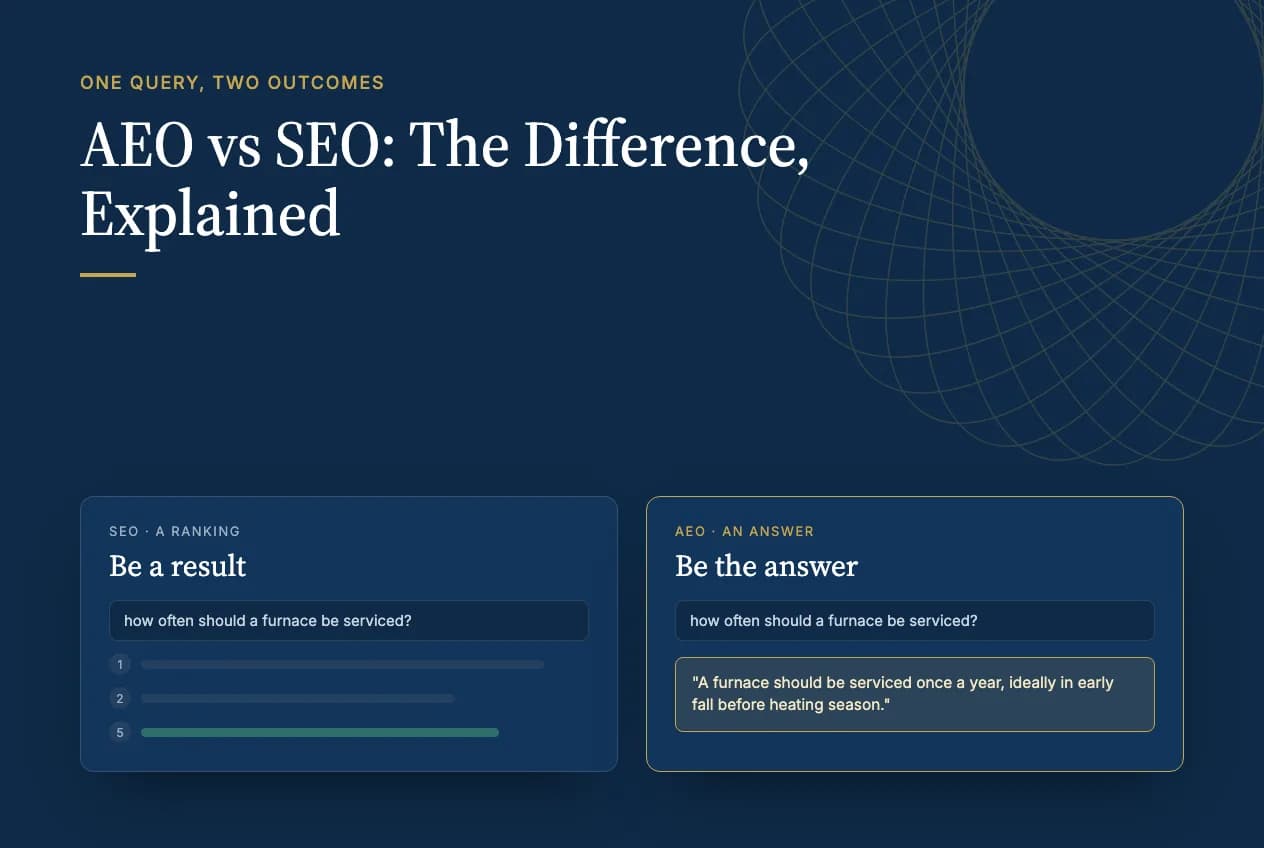
Short answer: SEO (search engine optimization) gets your page listed as a result. AEO (answer engine optimization) gets your words used as the answer: in featured snippets, People Also Ask boxes, Google AI Overviews, chatbots like ChatGPT and Perplexity, and voice assistants. SEO wins the ranking. AEO wins the quote.
The gap between the two matters more every month. In a Pew Research Center study of 68,879 real Google searches (July 2025), people clicked a regular result in 8% of visits when an AI summary appeared, versus 15% when none did. They clicked a source inside the summary just 1% of the time.
This guide explains what an answer engine does, how AEO changes the way you write, and why it still depends on SEO. Then it walks through one real-world query, shown first as a ranking and then as an answer.
What is the difference between AEO and SEO?
The difference between AEO and SEO is what gets chosen. SEO optimizes a whole page so a search engine ranks it in a list of links. AEO optimizes a specific passage so an answer engine can lift it, quote it or summarize it as the direct answer to a question, often with no click at all.
Both start from the same index and the same quality signals. They part ways at the last step: a search engine hands people options, an answer engine hands them a conclusion.
| SEO | AEO | |
|---|---|---|
| Goal | Be a result | Be the answer |
| What gets chosen | A whole page | A passage, fact or definition |
| Where it shows | Blue links on Google and Bing | Featured snippets, People Also Ask, AI Overviews and AI Mode, ChatGPT, Perplexity, Claude, Gemini, voice assistants |
| Typical query | Short keywords ("furnace service") | Full questions ("how often should a furnace be serviced?") |
| Content shape | Depth across the topic | A clear 40–60 word answer, then depth |
| Key signals | Relevance, links, technical health | Clarity, specificity, entity consistency, trust across the web |
| Win looks like | Position 1–10, a click | Your words or brand in the answer |
| How you measure | Rankings, clicks, CTR, conversions | Snippet ownership, AI citations and mentions, branded search lift |
In short: SEO earns the visit, AEO earns the mention. Most pages need to do both.
What does an "answer engine" actually do?
An answer engine is any system that responds to a question with an answer instead of a list of links. It finds candidate sources, picks the passages that answer best, and either quotes them or writes a summary from them. Google's featured snippets were the first mainstream answer engine; today the category includes AI Overviews, AI Mode, ChatGPT, Perplexity, Claude, Gemini and voice assistants.
That's why AEO is older than ChatGPT. The term took off in the late 2010s, when marketers started optimizing for featured snippets and smart speakers. Generative AI made answer engines far more common, but the job is the same: be the passage the machine trusts enough to repeat.
Most answer engines follow the same four steps:
- Interpret the question. The engine works out what's being asked. Complex prompts are often split into sub-questions; Google calls this "query fan-out" in AI Mode and AI Overviews.
- Retrieve candidates. It pulls pages from a search index. Google uses its own index. Chatbots use their own crawlers, partner indexes or, when they don't search, what they learned in training.
- Select passages. It scores sections, not whole pages, for how directly and reliably they answer each sub-question.
- Compose the answer. A featured snippet or voice assistant quotes one passage almost word for word. An AI Overview or chatbot blends several sources and may or may not link to them.
The practical upshot: an answer engine judges you paragraph by paragraph. A page can rank well and still lose the answer if its best sentence is buried, vague or depends on context three paragraphs up. Our guide to how generative engines choose what to cite goes deeper on the selection step.
How does AEO change the way you write a page?
AEO changes where the answer sits and how it's phrased, not what the page covers. You keep the depth SEO rewards and add three habits: lead each section with the answer, title sections the way people ask, and label the page so machines know what it is.
Answer-first blocks
Put a complete answer in the first 40–60 words under each heading, then explain. That length fits a featured snippet, a voice reply and a chatbot quote.
Write the block so it makes sense on its own. Name the subject instead of saying "it" or "this", include the key number or condition, and avoid phrases like "as mentioned above." If someone pasted only that paragraph into a reply, it should still be correct.
- Weak: "There are a lot of factors to consider, and it really depends on your system, but generally speaking it's a good idea to get it looked at fairly regularly."
- Strong: "A furnace should be serviced once a year, ideally in early fall before heating season. Annual service catches cracked heat exchangers and failing igniters early and keeps many manufacturer warranties valid."
Question headings
Phrase H2s and H3s as the questions your audience actually types or says. Answer engines match questions to passages, and a heading that mirrors the question tells them exactly where the answer starts.
Find the real wording in Google's People Also Ask boxes, the question-shaped queries in your Search Console Performance report, and the questions customers ask your sales or support team. Use one question per heading, and keep descriptive headings where a question would sound forced.
Schema
Schema markup labels what a page is, who wrote it and what it's about, in a format machines read without guessing. It helps answer engines connect your content to the right entities. It doesn't, on its own, earn a citation.
Two cautions the popular guides skip:
- FAQ and HowTo are no longer rich-result shortcuts. In August 2023 Google limited FAQ rich results to well-known government and health sites and later retired HowTo rich results entirely. FAQPage markup is still valid and still describes Q&A clearly, but it won't win most sites extra space in the results.
- There's no special "AI schema." Google's guidance on AI features says there are no additional technical requirements to appear in AI Overviews or AI Mode beyond being indexed and eligible to show a snippet.
The schema worth having on most sites is Organization (or LocalBusiness), Article with a named Person author, Product where relevant, and BreadcrumbList. Keep every value consistent with what the page visibly says.
One technical check sits under all three habits: machines must be able to read the page. Serve important text in the HTML rather than loading it with JavaScript, and don't block AI crawlers such as GPTBot, ClaudeBot or PerplexityBot in robots.txt unless you mean to. An llms.txt file is optional and unconfirmed by the major AI providers; robots.txt is what controls access. We cover which of these tactics the evidence actually supports in what the data says about AI search optimization.
Does AEO replace SEO?
No. AEO depends on SEO, because an answer engine can only quote pages it can find and trust. Google states that a page must be indexed and eligible to show a snippet before it can appear as a source in AI Overviews or AI Mode, with no additional requirements. Crawlability, relevance and authority are still the entry ticket, and that's the work of technical and on-page SEO.
What changes is how far SEO alone carries you, and that depends on the engine:
- Google's own answers (featured snippets, People Also Ask, AI Overviews) draw from Google's index, so strong rankings help a lot.
- Standalone assistants (ChatGPT, Gemini, Copilot) overlap much less with Google's rankings. An eMarketer analysis (November 2025) found that fewer than 10% of the sources they cited ranked in Google's top 10 for the same query.
So think of SEO as the foundation and AEO as the layer that decides whether your page becomes the answer. Skip SEO and engines can't find you; skip AEO and they find you but quote someone clearer. If you want help adding that layer to pages that already rank, that's what our answer engine optimization service does.
Example: one query, ranked vs answered
The clearest way to see the difference is to follow one question through both systems. Here the query is "how often should a furnace be serviced?" and the site belongs to a fictional local company, Northside Heating & Air. The page content is illustrative; the mechanics are real.
As a ranking (SEO)
Northside's furnace-maintenance page ranks fifth. In the results it looks like this:
Furnace Maintenance Guide | Northside Heating & Air
northsideheating.com › furnace-maintenance
Learn everything about furnace maintenance, from the history of forced-air heating to the parts inside your system. Call Northside today!
To learn the answer, a searcher has to choose this link over four above it, click, and scroll. The page opens with 150 words on how furnaces work; "once a year" first appears in the fourth paragraph. The page is relevant and well linked, so it ranks. But nothing on it is easy to quote.
As an answer (AEO)
Northside keeps the same page, the same URL and the same depth. It changes three things: an H2 that asks the question, a 50-word answer directly under it, and a short list of what a service visit includes. The new block reads:
How often should a furnace be serviced? A furnace should be serviced once a year, ideally in early fall before heating season starts. Annual service from a licensed technician catches problems like cracked heat exchangers and worn igniters early, improves efficiency, and keeps many manufacturer warranties valid. Northside Heating & Air services gas and electric furnaces across the metro area.
Now each answer surface has something to use:
| Surface | What the searcher sees | What Northside gets |
|---|---|---|
| Featured snippet | The first two sentences, quoted above the results | The top spot on the page, with a link |
| People Also Ask | The answer under "Do furnaces need to be serviced every year?" | A second placement for a related question |
| AI Overview | "Once a year, before heating season," with Northside among the source links | Brand exposure, a possible click |
| ChatGPT or Perplexity | An answer that names annual fall service and may cite or mention Northside | A mention at the moment of research |
| Voice assistant | One sentence read aloud, credited to the site | The only answer the listener hears |
The ranking still matters: it's how Google's answer features found the page in the first place. But the ranking alone offered a link. The rewritten block offers an answer, and five different surfaces can now use it. It's the same pattern we build into service pages for HVAC companies and other local trades.
To check whether a change like this worked, compare before and after on four signals: snippet and People Also Ask ownership for the query, mentions in a fixed set of AI prompts run monthly, referral sessions from AI assistants in GA4, and branded searches for the company name in Search Console.
Sources
Frequently asked questions
What does AEO stand for?
AEO stands for answer engine optimization. It's the practice of structuring content so systems that answer questions directly, such as Google's featured snippets and AI Overviews, ChatGPT, Perplexity and voice assistants, can find, trust and reuse it. The goal is to become the answer rather than one of the results.
Is AEO the same as GEO?
AEO and GEO overlap heavily but aren't identical. AEO covers every answer surface, including featured snippets and voice. GEO (generative engine optimization) focuses on generative AI tools like ChatGPT and AI Overviews, including how they describe your brand. In practice, the same work serves both.
Is AEO just optimizing for featured snippets?
No. Featured snippets were the first answer surface, so early AEO focused on them. Today AEO also covers People Also Ask, AI Overviews, AI Mode, chatbots and voice assistants. The core skill carries over: write a clear, self-contained answer that a machine can lift without losing its meaning.
Which should I do first, SEO or AEO?
Start with SEO if your pages aren't indexed or don't rank yet, because answer engines can't quote what they can't find. If you already rank, start AEO on those pages first: adding a question heading and a direct answer block to an existing ranking page is usually the fastest win.
How do I know if my content is being used in AI answers?
Track four things. Check snippet and People Also Ask ownership for your target questions. Run a fixed list of prompts in ChatGPT, Perplexity and Gemini each month and log mentions. Watch AI referral sessions in GA4, and branded search in Search Console, which includes AI Overview traffic in its overall data.
Do small and local businesses need AEO?
Yes, and they often benefit fastest. Local questions about costs, service intervals and permits trigger answer boxes and AI summaries constantly. A small business with clear answers, a consistent name, address and phone number across the web, and genuine reviews can be quoted ahead of much larger competitors.
Does schema markup guarantee a spot in AI answers?
No. Schema helps machines understand what a page is and who is behind it, but Google says there's no special markup or extra requirement for AI Overviews. Clear, accurate answers on an indexed, trusted page matter more. Use schema to describe your content honestly, not as a shortcut.
How long does AEO take to show results?
On pages that already rank, featured snippet and People Also Ask changes can show up within weeks of Google recrawling the page. AI assistant mentions usually take longer and vary more, because they depend on how often each tool searches the web and how widely your brand is discussed elsewhere.
Is AEO replacing SEO?
No. Answer engines can only quote pages they can find and trust, so SEO remains the foundation. Google says a page must be indexed and eligible for a snippet to appear in AI Overviews. What changes is that ranking alone no longer guarantees you're the source people actually see quoted.
Does ranking on Google get me into AI answers?
Partly. Google's own answer features draw from its index, so strong rankings help there. Standalone assistants overlap far less: eMarketer found fewer than 10% of the sources ChatGPT, Gemini and Copilot cited ranked in Google's top 10 for the same query, so they need their own tracking.
What is an answer engine?
An answer engine is any system that responds to a question with an answer instead of a list of links. Featured snippets were the first mainstream example; today the category includes Google's AI Overviews and AI Mode, ChatGPT, Perplexity, Claude, Gemini and voice assistants like Siri and Alexa.