
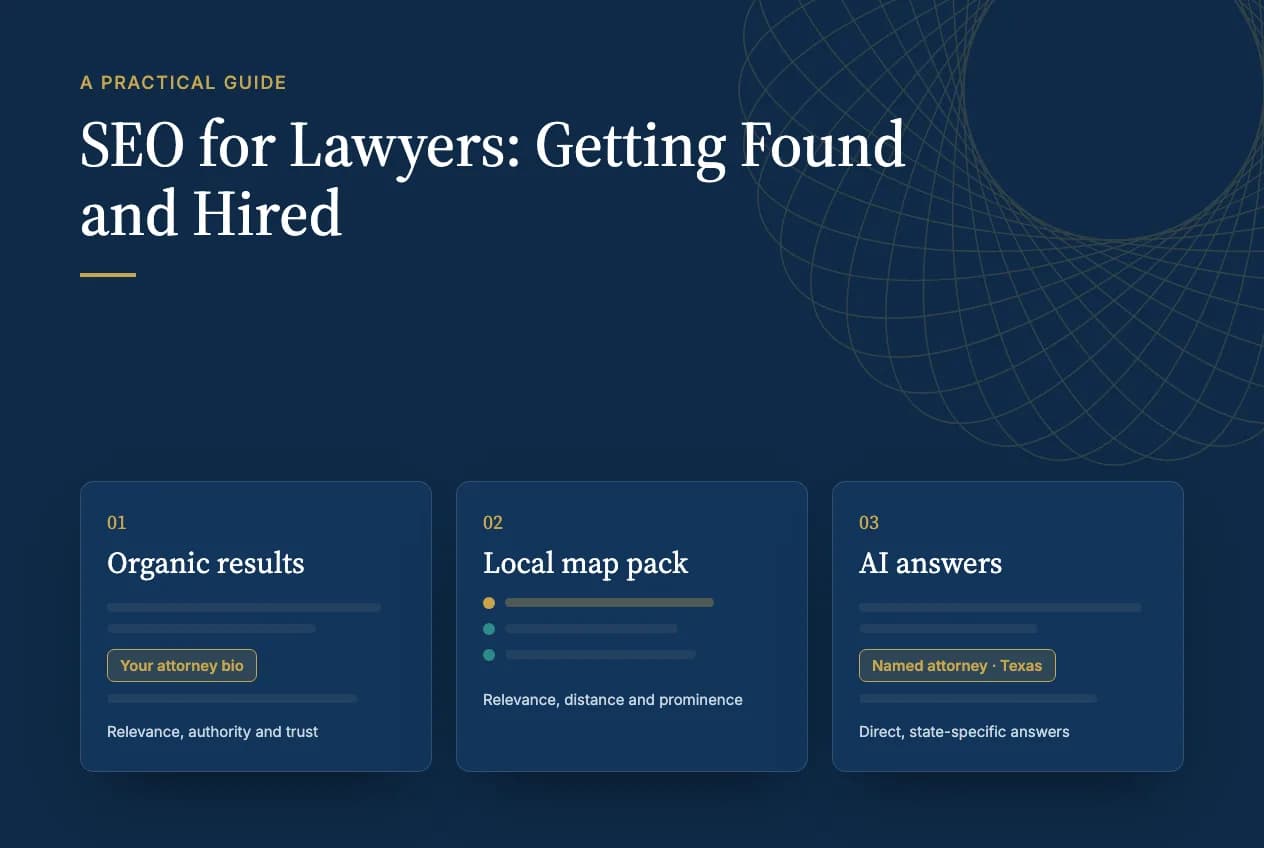
SEO for lawyers is the work of making an attorney or practice visible when people search for legal help. That means showing up in three places: Google's organic results, the local map pack and the answers AI assistants give. Done well, search engine optimization for lawyers turns those searches into consultations.
This guide is for solo attorneys, small practices and associates building their own profile. It covers how each kind of search result is decided, whether SEO is worth the money for your practice, what to fix yourself this month and how to tell whether it's working. By the end you should know whether to do it yourself, hire help or skip it for now.
How does SEO work for lawyers?
A potential client can find you in three places, and each one is ranked differently: the organic results, the local map pack and AI-generated answers. Most advice on SEO for lawyers only covers the first, but the map pack and AI answers often decide who gets the call.
| Organic results | Local map pack | AI answers | |
|---|---|---|---|
| Where it shows | The ten blue links | The three-business map box | ChatGPT, Perplexity, Gemini, AI Overviews |
| What drives it | Relevance, authority, trust signals | Relevance, distance, prominence | Direct answers, state-specific detail, a named author |
| What you control most | Your pages and your bio | Your Business Profile and reviews | How plainly your pages answer real questions |
Organic results
Google ranks pages by how well they match the search and how much it trusts the site. Legal topics face a higher bar. Google treats them as "Your Money or Your Life" subjects, where bad information can hurt someone, so it leans harder on signs of experience, expertise, authoritativeness and trust (E-E-A-T). Google's guidance on creating helpful, people-first content explains how this works. For a lawyer, that means named authors, real credentials and pages that answer the question rather than sell.
The local map pack
Google says local results are based mainly on three factors: relevance, distance and prominence. Its Business Profile help page on local ranking spells them out. You can't move your office closer to every searcher, so the work goes into relevance (categories, practice areas, a complete profile) and prominence (reviews, citations, links and how well known you are).
AI answers
ChatGPT, Perplexity, Gemini and Google's AI Overviews pull from pages that answer a question plainly, name the state the answer applies to and show who wrote it. A generic page about "car accident claims" is easy to skip. A page that answers "How long do I have to file a car accident claim in Texas?" in its first two sentences, under a named attorney, is easy to quote.
Is SEO worth it for lawyers?
Usually yes, when a single matter is worth more than a few months of SEO costs and your clients search before they call. Usually no, when your work comes almost entirely from referrals or your practice is so niche that hardly anyone searches for it.
The quickest way to decide whether SEO for lawyers pays in your practice is a break-even calculation. Here's a worked example with hypothetical numbers. Replace them with your own.
Break-even check (hypothetical)
Average fee per matter × consult-to-client rate × extra consults per month = extra monthly revenue
$4,000 × 25% × 4 = $4,000 a month
If SEO costs less than that once it's working, and you can wait for it to start working, it pays.
Compare SEO honestly with the alternatives:
| SEO | Pay-per-click ads | Referrals | |
|---|---|---|---|
| Speed | Months to build | Same week | Depends on your network |
| Cost over time | Falls per client as it compounds | Rises with competition; stops when you stop paying | Low cash cost, high time cost |
| Ownership | You keep the pages, profiles and reviews | You rent the position | You rely on other people |
Legal clicks are some of the most expensive in paid search, especially in personal injury, which is why many attorneys use ads for speed and SEO for what they'll keep.
When SEO isn't worth it (yet):
- Nearly all your clients come from referrals, and you're at capacity.
- Your practice area gets almost no searches in your state, such as a narrow regulatory niche.
- You can't take on more matters, or you plan to close or move the practice within a year.
- Your website can't be edited, and replacing it isn't in the budget.
- You need cases this month. Ads or referral outreach will be faster.
Local SEO for lawyers
Most legal searches have local intent. Someone searching "divorce lawyer" wants one they can meet, in their county and under their state's law. That makes the map pack the fastest win for most practices, and local SEO for lawyers starts with your Google Business Profile.
Google Business Profile
Google's guidelines for representing your business let individual practitioners, lawyers included, have their own profile alongside the firm's. If you're the only public-facing attorney at your practice, Google asks you to share a single profile with the firm, named in the format "Firm name: Attorney name". If you're one of several attorneys, you can have your own profile as well as the firm's.
Then complete it properly:
- Choose the most specific primary category, such as "Family law attorney" rather than just "Lawyer", and add secondary categories only for work you actually do.
- List your practice areas as services.
- Add real photos of your office and your team.
- Publish an occasional post answering a common client question.
Reviews within bar rules
Asking clients for reviews is generally allowed. Paying for reviews, offering anything in return for one or giving clients scripted wording is not. ABA Model Rules 7.1 and 7.2 cover misleading communications and giving value for recommendations, and each state adopts its own version. Check your state bar's rules on reviews and testimonials before you start asking. The ABA Model Rules of Professional Conduct are the starting point.
Citations
A citation is any listing of your name, address and phone number (NAP). Google and AI tools compare them to decide whether your practice is real and where it is. Keep them identical across Avvo, Justia, FindLaw, Martindale-Hubbell and your state bar directory, and fix old addresses first. Our full citation-building steps set out the order to work in.
Location pages
Create a location page only where you have an office or a genuine presence. Near-identical pages for every nearby town, with the city name swapped, rarely rank and can drag down the rest of the site. If you need help with multi-office setups, our local SEO service covers it.
Your attorney profile is an SEO asset
Your bio page is often the second page a potential client reads, and for searches that include your name it's the page that ranks. Many firms treat it as an afterthought. Treat it as a ranking asset.
Bio page checklist:
- Bar admissions, with the year and state for each
- Education, with the institutions named
- Practice focus in plain words: what you handle and for whom
- Published work, such as bar journal articles, guides and client resources
- Speaking engagements and CLE presentations
- A real, recent photo rather than a stock image
- Person schema with
sameAslinks to your bar listing, Avvo, Justia and LinkedIn profiles - A link from every page you've written or reviewed
Profiles that rank for your name:
- Avvo
- Justia
- Your state bar directory
- Super Lawyers, if you've been selected
- Martindale-Hubbell
Claim each one, use the same photo and wording for your practice focus, and link them back to your bio.
Write under your own name. On legal topics, Google and AI tools both favour content with a named, credentialed author. A page signed by an attorney, with a visible review date, is more likely to be trusted and cited than an anonymous post. Even if someone else drafts the content, review it and put your name on it.
How lawyers get cited in AI answers
AI tools cite pages that answer one specific question directly, for a specific state, under a named attorney. They skip pages that circle the question or answer for "most states".
Before (vague):
Every personal injury case is different, and the time you have to file depends on many factors. That's why it's important to speak to an experienced attorney as soon as possible after an accident.
After (answer-first, state-specific):
In Texas, you generally have two years from the date of a car accident to file a personal injury lawsuit. Some exceptions can shorten or extend that deadline, such as claims against a government entity. Written by [your name], attorney licensed in Texas.
The second version answers in the first sentence, names the state and shows who stands behind it. That's the pattern AI tools quote. Shaping pages this way is the core of answer engine optimization.
SEO by practice area
The method is the same for every practice, but the searches, the competition and the one tactic that matters most change a lot.
Why SEO matters for personal injury lawyers
Personal injury is where SEO matters most. Case values are high, paid clicks are among the most expensive in search, and the competition in big metros is fierce. People search in stages: first questions ("Is the insurer's offer fair?"), then lawyers. The firms that answer the early questions, per state, are the names people search next. The one tactic that matters most is state-specific question content under a named attorney. Our personal injury SEO page covers it in depth.
What's the best SEO for family lawyers?
Family law searches are emotional and private. People ask about custody, child support and divorce costs, often late at night, and the answers depend heavily on the state. Reviews are harder to get, because many clients don't want to be publicly linked to a divorce. That makes your profile strength matter more: a detailed bio, complete directory profiles and plain answers to state-specific custody and divorce questions.
Criminal defense
Criminal defense searches are urgent. They often happen on a phone, often at night, right after an arrest. The map pack and a click-to-call button matter more than long articles. Make your phone number unmissable on mobile, say clearly when you answer calls, and keep your Business Profile hours accurate.
Estate planning
Estate planning decisions are slow and researched. People compare wills and trusts, read about probate and come back several times before they call. Long-form answers to their questions win here, especially explanations of how probate works in your state and what each document costs.
What you can do yourself this month
You can finish this list in about four hours. It covers the foundations most lawyers never get round to.
- Claim and complete your Google Business Profile (45 minutes): category, practice areas, hours, photos.
- Fix your name, address and phone number on the top five directories (45 minutes): Avvo, Justia, FindLaw, Martindale-Hubbell and your state bar listing.
- Rewrite your bio page (60 minutes): use the checklist above.
- Ask five recent clients for a review (20 minutes): no incentives, no scripts, and within your state bar's rules.
- Answer one common client question per practice area (45 minutes): one direct, state-specific paragraph each, signed with your name.
- Set up Google Search Console (15 minutes): Search Console shows which searches already find you.
- Add a "How did you hear about us?" question to intake (10 minutes): this is how you'll know what's working.
How to track SEO results as a lawyer
Track signed cases by source, not just rankings. Rankings move every day. Signed matters are the number that pays.
| Metric | Tool | How often to check |
|---|---|---|
| Search queries, impressions and clicks | Google Search Console | Monthly |
| Calls, direction requests and website clicks | Google Business Profile performance | Monthly |
| Calls by source | Call tracking with dynamic number insertion | Monthly |
| How new clients found you | A "How did you hear about us?" field in intake | Every new client |
| AI citations | Manual checks of 10 key questions in ChatGPT, Perplexity and Gemini | Monthly |
| Signed cases from search | Intake records matched to source | Quarterly |
Dynamic number insertion shows each visitor a tracking number based on how they arrived, so you can tell a call from search apart from a call from an ad. For AI citations, pick the ten questions your best clients ask before hiring. Run them each month, note which firms are named, and see whether you're one of them.
When to hire SEO services for lawyers
Hire help when you've done the do-it-yourself list and your market is still competitive, or when an hour of your time is worth more billed than spent optimising. Agencies earn their fee on technical fixes, content at scale and links. Those are hard to do well a few hours a month.
Five questions to ask any agency:
- Which law firms do you work with now, and do any compete with me in my market?
- Who writes the content, and does an attorney review it before it's published?
- What will you report each month, and does it include calls and signed cases?
- Do I own the content, the website and the accounts if we part ways?
- What's the notice period, and what happens in the first 90 days?
Four red flags:
- Guaranteed rankings. Nobody controls Google's results.
- Content you don't own. If you leave, the pages should stay with you.
- Long lock-in contracts. Good work doesn't need a 12-month trap.
- Working with your direct competitors in the same practice area and market.
If you'd rather hand it over, see our law firm SEO services.
Where to start
Want to see where you stand in Google and AI answers? Get a free AI-search audit. We'll show you which client questions name other firms instead of yours, and what to fix first.
This guide is marketing guidance, not legal advice. Check your state bar's rules before acting on anything here that touches advertising, reviews or client communications.
Frequently asked questions
Is SEO for lawyers different from SEO for law firms?
Not in its foundations. Both rely on a healthy website, useful content, reviews and consistent directory listings. Individual lawyers lean more on personal assets: bio pages, Avvo and bar profiles, and their own Google Business Profile. Firms lean more on practice-area pages and local SEO across several offices, which our law firm SEO page covers in depth.
How much does SEO cost for lawyers?
There's no single price, because three things drive the cost: your practice area, the size of your market and how many offices you have. Competing in personal injury in a large metro takes far more work than estate planning in a small town. A free audit gives you a real figure for your practice before you commit to anything.
How long does SEO take for lawyers?
Map pack gains and first AI citations usually take weeks to a few months, while competitive organic terms take six to twelve months or more. The timeline table on our law firm SEO page breaks this down by type of win and by what drives each one.
Can lawyers do their own SEO?
Yes, for the foundations. Claiming your Business Profile, fixing directory listings, rewriting your bio and asking for reviews take time, not specialist skills. Technical fixes, content at scale and earning links are harder to do well in a few hours a month. Start with the do-it-yourself list in this guide.
Do lawyers need a blog for SEO?
No, not a blog for its own sake. What helps is question-and-answer content your clients actually search for, specific to your state and reviewed by an attorney. Ten strong pages that each answer a real question will do more than a hundred thin posts written to fill a content calendar.
Are paid directory listings like Avvo Pro or FindLaw worth it?
Sometimes. Free profiles on Avvo, Justia and FindLaw are worth claiming, because they act as citations. Paid upgrades are worth it only if the directory itself sends you measurable consultations. Give each paid listing its own tracking number for a few months, and keep paying only if those calls turn into clients.
Can lawyers ask clients for Google reviews?
Generally yes, as long as you offer nothing in return and don't script or steer what clients write. Rules vary by state, and some bars have specific guidance on reviews and testimonials, so check yours before you start asking. This is general marketing guidance, not legal advice.